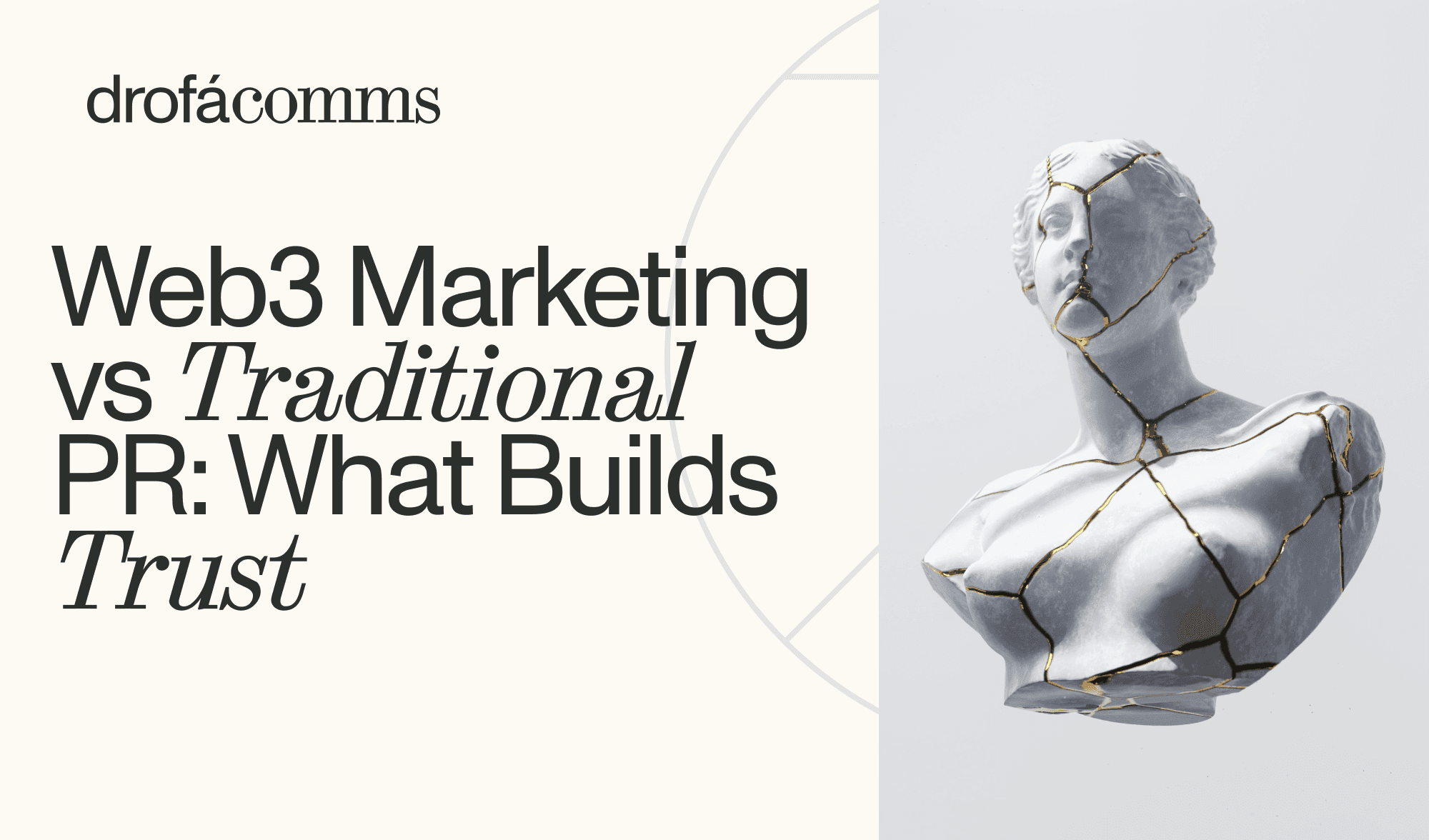
At the beginning of this month, we took part in the Onboard2023 conference focused on Web3 marketing. After reviewing what teams are actively debating in this space, we decided to share our view on how Web3 promotion compares with traditional PR, and where each approach delivers real value.
The concept of Web 3.0 remains a major topic. Its decentralised narrative is often tied to content creation, community ownership, and new ways for projects to reach people. At the same time, the Web 2.0 era already reshaped promotion. Influencers, cross-channel marketing, and geo-targeted ads are now standard tools in the brand-building toolkit.
What Web3 Marketing Tries to Add
The idea behind Web3 marketing is to push these practices further by making campaigns more precise and more measurable. In simple terms, teams aim to use blockchain mechanics to build data-driven relationships with their audiences and to make incentives, participation, and attribution easier to track.
That said, we still see too much vagueness in how Web3 marketing is described. For many people, the practical value remains unclear, and the gap between “big promise” and “clear execution” is still real. Because of that, the “Web2 marketers are under threat” narrative often sounds more like positioning than reality. In our view, the more likely outcome is synergy: community-led growth plus credibility-led storytelling.
Trust Still Needs Proof
Many crypto and fintech projects promote themselves by launching groups on Discord, X (Twitter), and other social platforms to speak to the community directly. This works well for speed: it helps gather early attention, feedback, and engagement.
The issue is that community presence alone rarely sustains a reputation. Without independent coverage, it is still hard to maintain the image of a reliable project rather than a fly-by-night one. When a market is crowded, and scams are part of the public memory, audiences look for signals outside a project’s own channels.
What Traditional PR Still Delivers for Web3 Brands
Traditional PR remains one of the most effective ways to establish legitimacy in the eyes of stakeholders who care about track record, governance, and risk. Strong media coverage also creates a lasting footprint that community content usually can’t replace.
PR helps teams build:
Third-party validation through editorial standards and independent scrutiny
A narrative that stays consistent across markets, products, and spokespeople
Reputational resilience during volatility, incidents, or market downturns
Access to a more analytical audience: partners, institutions, regulators, and enterprise buyers
It also forces clarity. When editors ask the hard questions, messaging becomes sharper, definitions become cleaner, and claims become easier to defend.
Conclusion: How We Combine Both
At Drofa Comms, we do not treat PR as “being visible.” We refer to it as being understood by the right people. We build narratives that match what the market can verify, and secure in-depth coverage in media that carries weight in its field.
In practice, the strongest strategy is to run community and PR together: community builds momentum and closeness, while PR builds trust and long-term positioning.

Schedule your free consultation
A review of your current communications activities
General recommendations on what to focus on
PR Consultant's vision on how PR could help your business growth
other materials
All articles