April has come to an end, and the time is ripe to sum it up. From the world-shocking bankruptcies to fast-moving innovation, these are some of the topics that have been shaping TradFi, fintech, and crypto.
The U.S. banking crisis that dominated March kept spilling into April. First Republic Bank’s shares fell 95% from March 8 as the lender struggled to secure a private-sector rescue coordinated by U.S. officials, with rising rates and an aggressive growth strategy fueling a sharp deposit outflow. Zooming out, the macro picture also stayed heavy. The IMF published its latest growth expectations for the global economy, projecting roughly 3% growth — its weakest medium-term forecast since 1990.
Crypto had its own turbulence. Over recent months, the SEC moved against multiple major market players, including Gemini, Bittrex, and the bankrupt lender Genesis. Then the story flipped: Coinbase filed a lawsuit against the SEC, arguing for clarity on whether existing securities rules apply to crypto, while also signaling it could consider moving its HQ to the UK amid U.S. regulatory uncertainty.
Innovation headlines also carried a risk signal. Rapid progress in AI and ML has pushed regulators to respond, with the EU advancing what is positioned as a first-of-its-kind regulatory framework around AI. The debate now sits between speed, safety, and competitiveness.
Below is our April digest.
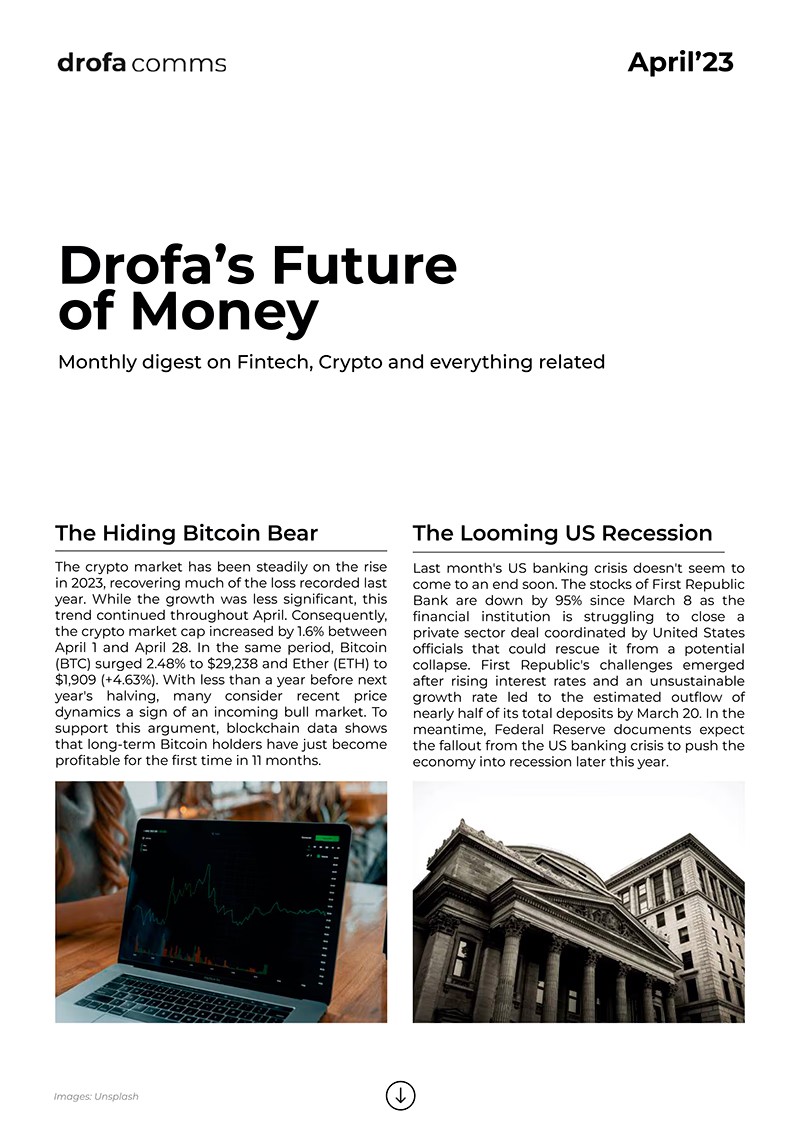
The Hiding Bitcoin Bear
The crypto market has been steadily on the rise in 2023, recovering much of the loss recorded last year. While the growth was less significant, this trend continued throughout April. Consequently, the crypto market cap increased by 1.6% between April 1 and April 28. In the same period, Bitcoin (BTC) surged 2.48% to $29,238 and Ether (ETH) to $1,909 (4.53%). With less than a year before next year’s halving, many consider recent price dynamics a sign of an incoming bull market. To support this argument, blockchain data shows that long-term Bitcoin holders have just become profitable for the first time in 11 months.
The Looming US Recession
Last month’s US banking crisis doesn’t seem to come to an end soon. The stocks of First Republic Bank are down by 95% since March 8 as the financial institution is struggling to close a private sector deal coordinated by United States officials that could rescue it from a potential collapse. First Republic’s challenges emerged after rising interest rates and an unsustainable growth rate led to the estimated outflow of nearly half of its total deposits by March 20. In the meantime, Federal Reserve documents expect the fallout from the US banking crisis to push the economy into recession later this year.
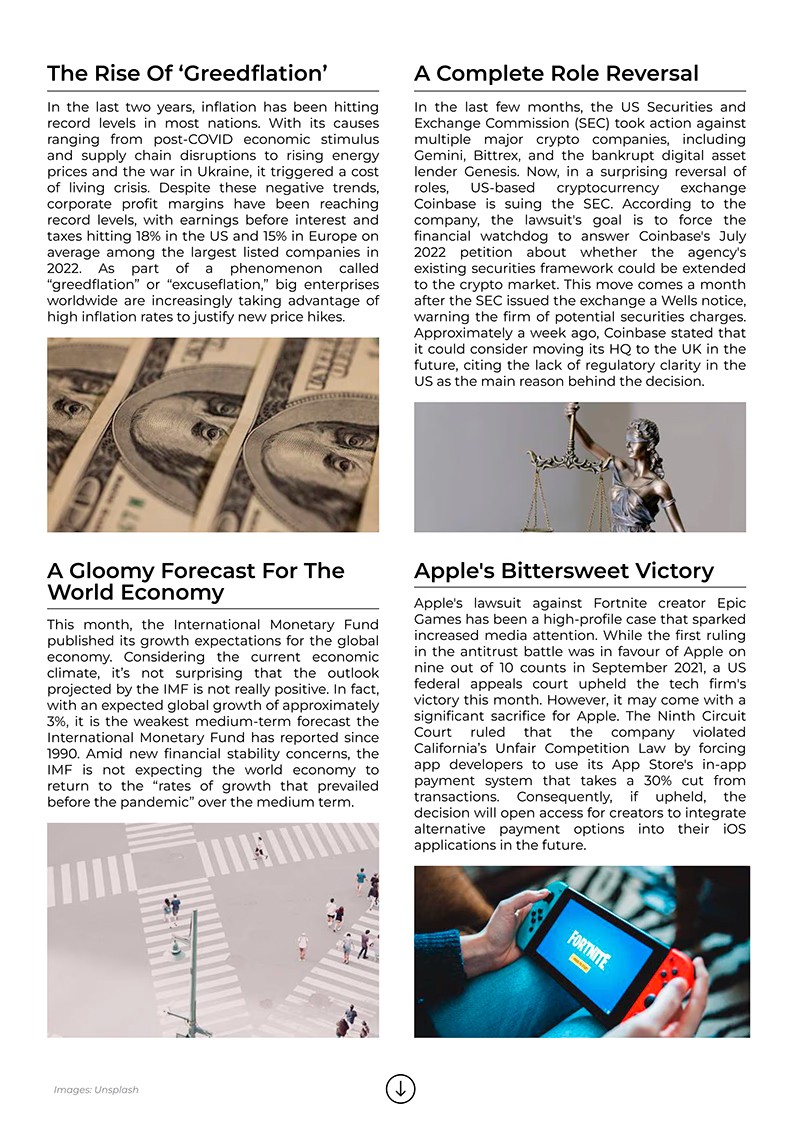
The Rise Of “Greedflation”
In the last two years, inflation has been hitting record levels in most nations. With its causes ranging from post-COVID economic stimulus and supply chain disruptions to rising energy prices and the war in Ukraine, it triggered a cost of living crisis. Despite these negative trends, corporate profit margins have been reaching record levels, with earnings before interest and taxes hitting 18% in the US and 15% in Europe on average among the largest listed companies in 2022. As part of a phenomenon called “greedflation” or “excuseflation”, big enterprises worldwide are increasingly taking advantage of high inflation rates to justify new price hikes.
A Gloomy Forecast For The World Economy
This month, the International Monetary Fund published its growth expectations for the global economy. Considering the current economic climate, it’s not surprising that the outlook projected by the IMF is not really positive. In fact, with an expected global growth of approximately 3%, it is the weakest medium-term forecast the International Monetary Fund has reported since 1990. Amid new financial stability concerns, the IMF is not expecting the world economy to return to the “rates of growth that prevailed before the pandemic” over the medium term.
A Complete Role Reversal
In the last few months, the US Securities and Exchange Commission (SEC) took action against multiple major crypto companies, including Gemini, Bittrex, and the bankrupt digital asset lender Genesis. Now, in a surprising reversal of roles, US-based cryptocurrency exchange Coinbase is suing the SEC. According to the company, the lawsuit’s goal is to force the financial watchdog to answer Coinbase’s July 2022 petition about whether the agency’s existing securities framework could be extended to the crypto market. This move comes a month after the SEC issued the exchange a Wells notice, warning the firm of potential securities charges. Approximately a week ago, Coinbase stated that it could consider moving its HQ to the UK in the future, citing the lack of regulatory clarity in the US as the main reason behind the decision.
Apple’s Bittersweet Victory
Apple’s lawsuit against Fortnite creator Epic Games has been a high-profile case that sparked increased media attention. While the first ruling in the antitrust battle was in favour of Apple on nine out of 10 counts in September 2021, a US federal appeals court upheld the tech firm’s victory this month. However, it may come with a significant sacrifice for Apple. The Ninth Circuit Court ruled that the company violated California’s Unfair Competition Law by forcing app developers to use its App Store’s in-app payment system that takes a 30% cut from transactions. Consequently, if upheld, the decision will open access for creators to integrate alternative payment options into their iOS applications in the future.
The Endless Fight Against Inflation
Central banks worldwide are in a tough situation, as they are continuously working to curb the inflation rate, lessening the impact of the ongoing cost of living crisis. In Germany, this fight has already yielded positive results, with consumer prices increasing 7.6% in April, down from March’s 7.8% and February’s 8.7%. On the other hand, inflation pressure still remains a problem in the US, with the personal consumption expenditures (PCE) price index excluding food and energy increasing by 0.3% between February and March with a 4.6% YoY growth. At the same time, while the European Central Bank (ECB) is expected to slow its rate hike in the coming weeks, the Bank of Japan (BOJ) is keeping interest rate levels at very low levels and remains committed to economic stimulus.
A Tough Stance On Crypto
Last December, US senators Elizabeth Warren and Roger Marshall introduced the Digital Asset Anti-Money Laundering Act Of 2022, which would come with strict rules for most crypto organizations. As per the bill, wallet services, miners, and many other digital asset providers would be considered money services businesses that must complete Know Your Customer (KYC) checks on their users. The proposed legislation received harsh criticism from industry participants, citing overly strict rules that could hinder innovation in the United States. Despite the opposition, the duo of senators sought to double down on their tough stance on crypto by reintroducing the bill this month. However, Warren and Marshall decided to delay their planned move due to a lack of cosponsors.
Crypto’s Role In The US Banking Crisis
After the collapse of the crypto-friendly Signature and Silvergate banks, many were quick to blame the cryptocurrency industry. However, according to a new Congressional Research report, digital assets only played an indirect role in the events. While Silvergate’s high-risk Bitcoin collateralized loans didn’t cause any losses or forced liquidations for the firm, only 20% of Signature’s outflows were from crypto clients. Moreover, Signature’s exposure to FTX and Celsius represented only 0.2% of its total deposits. So instead of crypto, New York State Department of Financial Services Superintendent Adrienne Harris argued that the cause of the crisis was a bank run by “a broad base of depositors across business sectors”.
Sealing The AI Deal
Recent breakthroughs in artificial intelligence have significantly increased the pace of AI and ML development across the world. However, a sudden advancement in a nascent technology with the potential to replace the equivalent of 300 million jobs in the future has become a concern for industry participants and regulators. Amid calls to pause the training of AI models for six months by the likes of Elon Musk and Steve Wozniak, EU lawmakers passed the draft of the world’s first regulatory framework around artificial intelligence on April 27. While the proposed bill aims to decrease the risks of the technology, critics argue that its overly strict rules could put European industry firms further behind US and Chinese companies in the artificial intelligence race.
Conclusion
April reinforced a consistent pattern across markets: macro stress sets the tempo, regulators raise the bar, and technology keeps moving anyway. Banking fragility, sticky inflation, and a heavier enforcement posture continue to shape risk appetite, while crypto and fintech players adjust their strategy around legal clarity, payments rails, and platform power. AI adds a second acceleration curve — innovation that scales fast, plus governance that is trying to catch up.
Stay tuned for our monthly news summaries and if you are hungry for more (just like we are) — follow us on LinkedIn for market tendencies, hot news, and PR tools.

Schedule your free consultation
A review of your current communications activities
General recommendations on what to focus on
PR Consultant's vision on how PR could help your business growth
other materials
All articles