
October is the scariest month of the year, and the reason went beyond Halloween. Cointelegraph flagged a harsh milestone: by October 31, 2022, stolen crypto funds reached $2.98B, roughly double the $1.55B recorded in 2021. The figures were based on data from blockchain security firm PeckShield.
Hacktober also delivered headlines outside security. Elon Musk became “Chief Twit,” turning Twitter upside down overnight. Meta kept bleeding revenue and started facing louder internal questions about the size of its metaverse bet. Market mood improved at the margin: since September 30, Bitcoin rose 6.2% and Ethereum gained 17.55%, offering a rare stretch of relief for the sector.
The Heist Of The Year
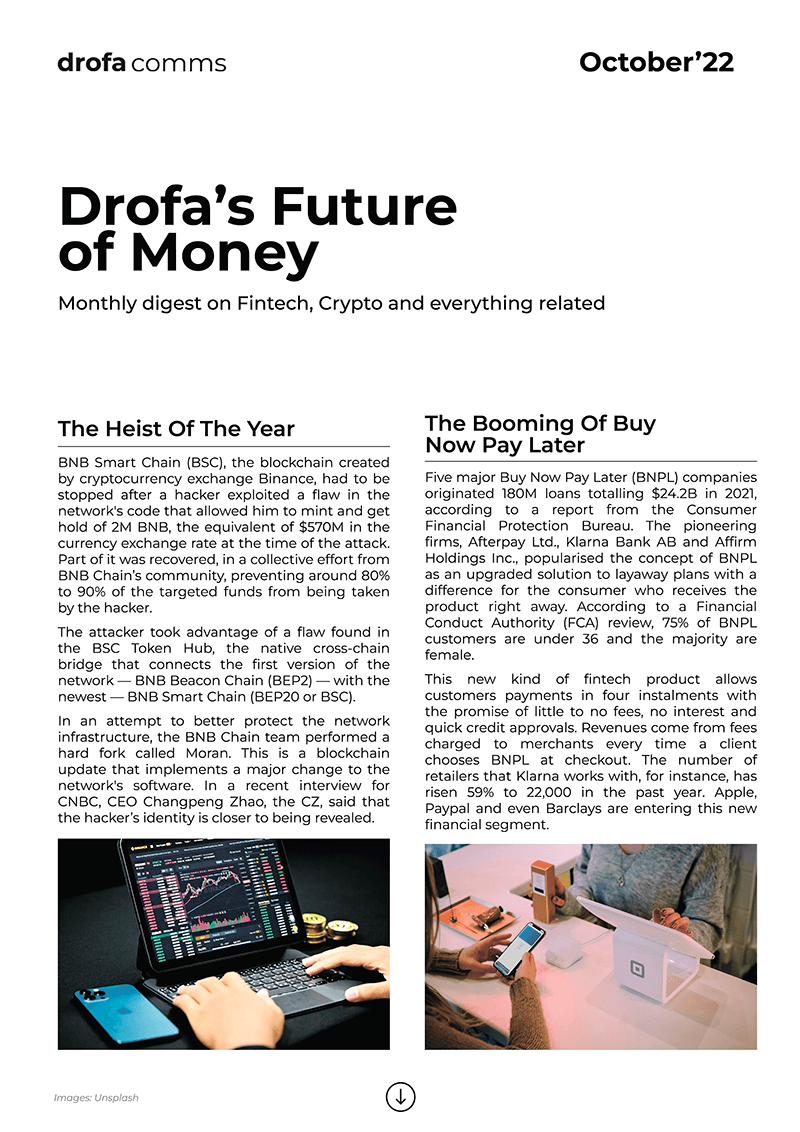
BNB Smart Chain (BSC), the blockchain created by cryptocurrency exchange Binance, had to be stopped after a hacker exploited a flaw in the network’s code that allowed him to mint and get hold of 2M BNB, the equivalent of $570M in the currency exchange rate at the time of the attack. Part of it was recovered, in a collective effort from BNB Chain’s community, preventing around 80% to 90% of the targeted funds from being taken by the hacker.
The attacker took advantage of a flaw found in the BSC Token Hub, the native cross-chain bridge that connects the first version of the network — BNB Beacon Chain (BEP2) — with the newest — BNB Smart Chain (BEP20 or BSC).
In an attempt to better protect the network infrastructure, the BNB Chain team performed a hard fork called Moran. This is a blockchain update that implements a major change to the network’s software. In a recent interview for CNBC, CEO Changpeng Zhao, CZ, said that the hacker’s identity is closer to being revealed.
The Booming Of Buy Now Pay Later
Five major Buy Now Pay Later (BNPL) companies originated 180M loans totalling $24.2B in 2021, according to a report from the Consumer Financial Protection Bureau. The pioneering firms, Afterpay Ltd., Klarna Bank AB and Affirm Holdings Inc., popularised the concept of BNPL as an upgraded solution to layaway plans, with the consumer receiving the product right away. According to a Financial Conduct Authority (FCA) review, 75% of BNPL customers are under 36 and the majority are female.
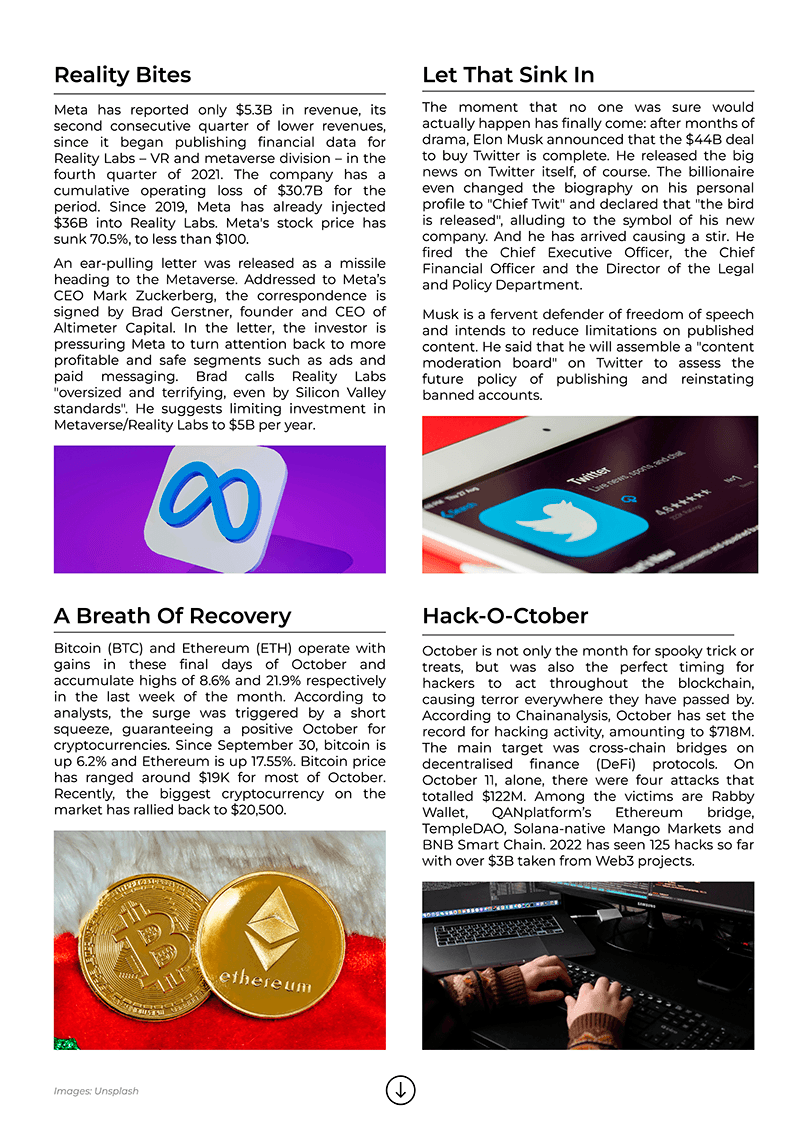
This new kind of fintech product allows customers payments in four installments with the promise of little to no fees, no interest and quick credit approvals. Revenues come from fees charged to merchants every time a client chooses BNPL at checkout. The number of retailers that Klarna works with, for instance, has risen 59% to 22,000 in the past year. Apple, PayPal and even Barclays are entering this new financial segment.
Reality Bites
Meta has reported only $5.38 in revenue, its second consecutive quarter of lower revenues, since it began publishing financial data for Reality Labs — VR and metaverse division — in the fourth quarter of 2021. The company has a cumulative operating loss of $30.7B for the period. Since 2019, Meta has already injected $368 into Reality Labs. Meta’s stock price has sunk 70.5%, to less than $100.
An ear-pulling letter was released as a missile heading to the Metaverse. Addressed to Meta’s CEO Mark Zuckerberg, the correspondence is signed by Brad Gerstner, founder and CEO of Altimeter Capital. In the letter, the investor is pressuring Meta to turn attention back to more profitable and safe segments such as ads and paid messaging. Brad calls Reality Labs “oversized and terrifying, even by Silicon Valley standards”. He suggests limiting investment in Metaverse/Reality Labs to $5B per year.
A Breath Of Recovery
Bitcoin (BTC) and Ethereum (ETH) operate with gains in these final days of October and accumulate highs of 8.6% and 21.9% respectively in the last week of the month. According to analysts, the surge was triggered by a short squeeze, guaranteeing a positive October for cryptocurrencies. Since September 30, bitcoin is up 6.2% and Ethereum is up 17.58%. Bitcoin price has ranged around $19K for most of October. Recently, the biggest cryptocurrency on the market has rallied back to $20,500.
Let That Sink In
The moment that no one was sure would actually happen has finally come: after months of drama, Elon Musk announced that the $44B deal to buy Twitter is complete. He released the big news on Twitter itself, of course. The billionaire even changed the biography on his personal profile to “Chief Twit” and declared that “the bird is released”, alluding to the symbol of his new company. And he has arrived causing a stir. He fired the Chief Executive Officer, the Chief Financial Officer and the Director of the Legal and Policy Department.
Musk is a fervent defender of freedom of speech and intends to reduce limitations on published content. He said that he will assemble a “content moderation board” on Twitter to assess the future policy of publishing and reinstating banned accounts.
Hack-O-Ctober
October is not only the month for spooky trick or treat, but is also the perfect timing for hackers to act throughout the blockchain, causing terror everywhere they have passed by. According to Chainalysis, October has set the record for hacking activity, amounting to $718M. The main target was cross-chain bridges on decentralised finance (DeFi) protocols. On October 11 alone, there were four attacks that totalled $122M. Among the victims are Rabby Wallet, QANplatform’s Ethereum bridge, TempleDAO, Solana-native Mango Markets and BNB Smart Chain. 2022 has seen 125 hacks so far with over $3B taken from Web3 projects.
Al6z Bets In Latam
Despite losses of 40% in the first half of the year, Andreessen Horowitz’s a16z, one of the most influential venture capitals in Silicon Valley, with $35B in assets under management, said it remains faithful to Web3. Chris Dixon, the founder of a16z’s crypto arm, believes in a long-term horizon as this industry is at its early stages.
It seems, however, that they have new targets in Latin America. In the last week of October, executives of the VC firm were in Brazil, seeking new opportunities in fintechs and health techs. Scott Kupor, managing partner at a16z; David Haber, a general partner focused on fintechs; Jen Kha, Head of investor relations and fundraising; and Gabriel Vasquez, one of the partners focused on prospecting startups in Latin America. They had meetings with BTG Pactual — one of the main Brazilian investment banks — and Latitud, an entrepreneurship hub founded by Brian Requarth, Gina Gotthilf and Yuri Danilchenko, to which a16z led a seeding investment of $1.5M last March. The company has already invested in 19 startups in the region, including unicorns Rappi, Loft and Bitso.
Conclusion
October reinforced the industry’s current reality: security failures keep setting the agenda, while consumer fintech products and institutional capital continue to expand in parallel. Hacktober’s numbers showed how much value still sits in fragile plumbing — bridges, wallets, and DeFi rails — while BNPL’s growth confirmed that “embedded credit” is becoming a default checkout option for younger users.
On the corporate side, Big Tech’s Web3 narrative matured into cost discipline and governance questions, and crypto markets showed a small recovery that rewarded positioning and patience. The next months look set to be shaped by three forces moving together: tougher oversight, tighter risk management, and selective capital deployment into regions and products that can prove resilience.
Stay tuned for our monthly news summaries and if you are hungry for more (just like we are) — follow us on LinkedIn for market tendencies, hot news, and PR tools.

Schedule your free consultation
A review of your current communications activities
General recommendations on what to focus on
PR Consultant's vision on how PR could help your business growth
other materials
All articles