In the earlier piece, we mapped the NFT market in 2026 at the macro level: adoption reality, the trust gap, and the use cases that still hold up once resale narratives lose momentum. This time, the lens is narrower. We look at NFT brand strategy as a communications and PR instrument, and at what token launches do to reputation in a market where scepticism is the default.
The 2021–2022 aftermath still shapes perception. NFTs became linked to hype economics, blurry promises, and projects that failed to succeed. So, in 2026, many readers don’t start with “Is this innovative?” They wonder, “Is this credible?” That means they want to know what access the token grants, what rights it carries, how support works, and what happens when something breaks.
That is why this time, we would like to focus on practical deployments that hold up under scrutiny: token-gated communities, ticketing and access layers, and NFT launches built on clear terms and reliable delivery.
NFT Brand Strategy as a PR Product in 2026
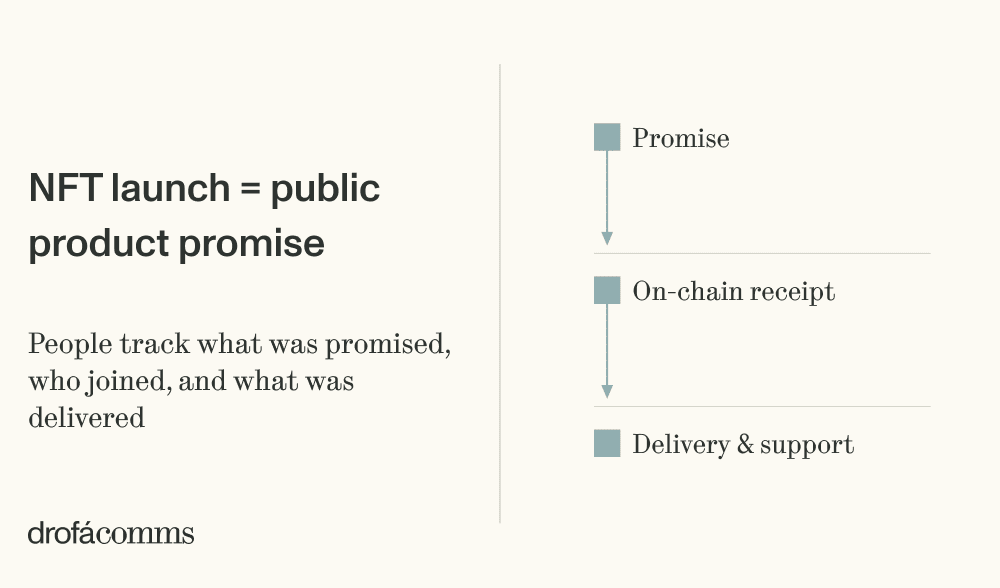
In 2026, an NFT release is rarely “just marketing.” It works more like a product launch that happens in public. People can see what was promised, who bought in, and what was delivered. That makes explicit messaging and consistency more important because blind spots are easy to detect and hard to defend.
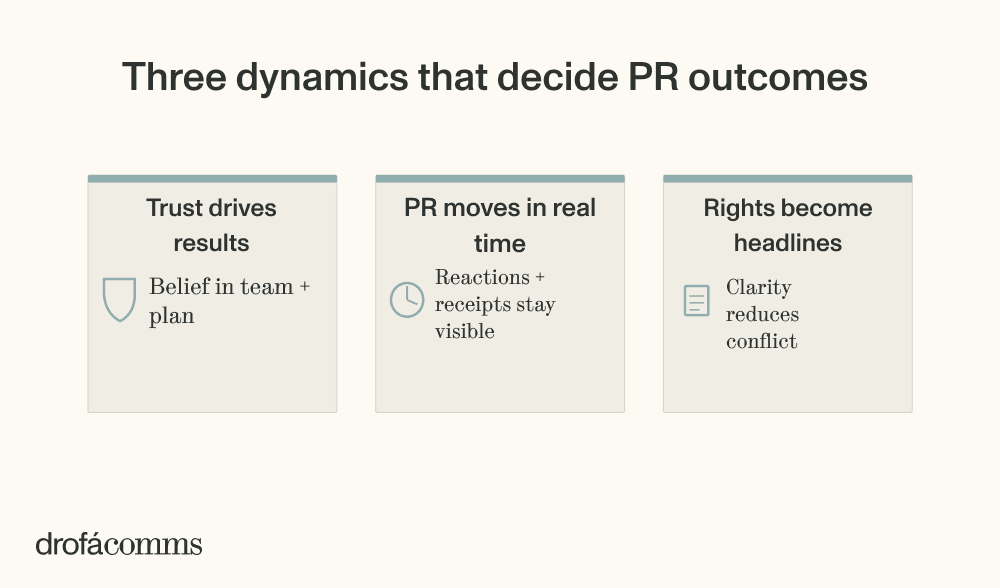
Three dynamics explain this shift:
- First, trust drives results.
Research on NFT communities keeps focusing on the same theme: a lively community helps, but it does not guarantee long-term value. Projects last longer when people trust the team and believe it has a real plan. Otherwise, when the message is vague, groups fill the gap with rumours, anger, and “I’m out” posts.
- Second, NFT launches trigger real-time PR.
In a traditional brand campaign, you can rewrite copy, adjust targeting, update FAQs, and swap creatives, and most people only see the updated version. An NFT launch leaves less room for invisible iteration.
The offer (price, supply, rules, utility, rights) is debated in public while the launch is happening, and early confusion spreads fast. People can also track basic launch details like timing, supply, and distribution. That shortens the response window. So, if the team clarifies late, the first narrative often stays online and keeps shaping opinion.
- Third, rights and licensing can turn into a PR problem.
If terms are vague, people assume they own more rights than they do. In this environment, creators, buyers, and media start arguing. That way, the story transforms from “new product” to “conflict.”
Taken together, these dynamics mean PR has to be built into the launch plan early, alongside product, legal, and support.
How a PR Campaign Supports NFT Launches
A well-structured NFT brand strategy starts with PR built into the launch plan:
- Translate “utility” into clear benefits: what holders get, when they get it, and how they access it.
- Make the rules readable: rights, eligibility, redemption steps, limits, and what can change later.
- Build the launch communication system: key messages, channel timing, FAQ, community guidelines, and one page that stays updated.
- Prepare for live scrutiny: monitoring, consistent moderation replies, escalation paths to legal/product/support, and a plan for delivery updates after launch.
That way, the public story stays aligned with what the brand can actually deliver, and confusion is less likely to become the headline.
The 2026 PR Playbook: Where NFTs Create Reputation Value
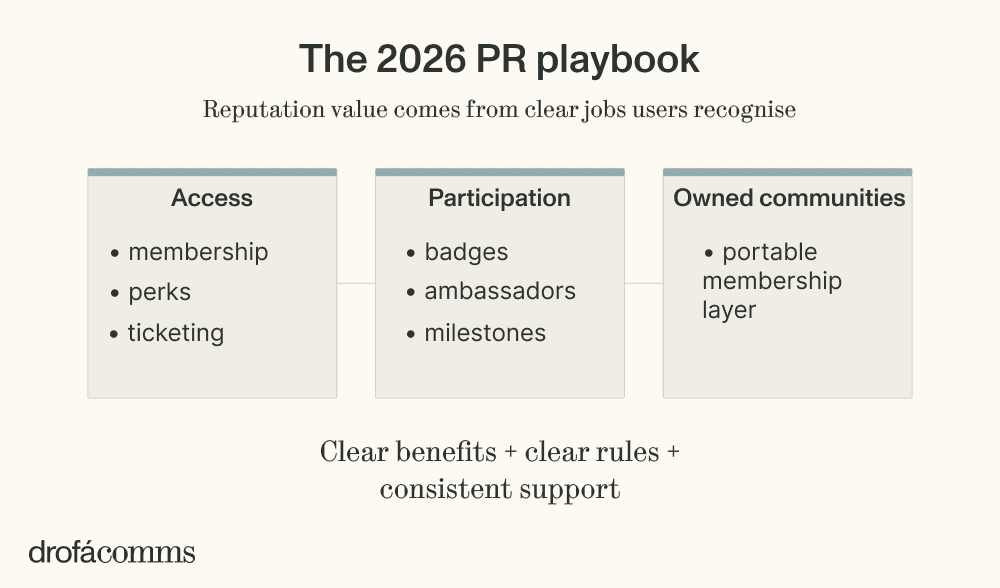
NFTs still work in 2026 when they do a job people understand. The strongest uses sit in three areas: access, participation, and owned communities.
Token-gated access that feels like a benefit
This is the cleanest use case because it sells a function. Think memberships, season passes, tickets, and verified perks. It also avoids the “buy now, resell later” framing that makes many people sceptical.
Formats that tend to work:
- Membership tiers that unlock content, events, or early product access;
- Ticketing and attendance tokens that act as a digital pass and a keepsake;
- Partner perks are bundled with defined rules on who qualifies and how to redeem.
Participation records that power communities
Tokens can also serve as proof that someone showed up, contributed, or hit a milestone. For PR, this supports a simple advocacy flow: spot the most active members, reward them, and give them reasons to share their involvement publicly.
What works in practice:
- Ambassador programmes with understandable entry rules and rewards;
- Contribution badges tied to real actions (testing, feedback, referrals, content);
- Event series where attendance builds status and unlocks better access over time.
Brand-owned communities that don’t depend on platforms
In 2026, brands are more cautious about building everything on rented reach. Algorithms change, moderation rules shift, and accounts get limited with little warning. NFTs can help create a membership layer that the brand controls.
The token acts as a key that unlocks the same benefits across different channels, such as community spaces, events, content, product access, and partner perks. This reduces fragmentation. Members don’t need to prove themselves again in every new platform or campaign. So, the token becomes a stable link between the brand and the user, and that stability is what makes the community feel “real.”
Conclusion: NFT Brand Strategy in 2026 Reward Trust-First PR
The NFT market in 2026 is an execution filter, and PR is part of the execution. Tokens make both good work and bad work more visible. When a brand offers real access, explains rights, supports users, and communicates directly, NFTs can become a scalable community tool. When a team leans on hype language, vague “utility,” or price-led narratives, the programme can turn into reputational debt.
The rule for 2026 is to treat NFTs like a customer product, with determined terms, legal clarity, and real support. Since at our agency we work where PR meets technology, we refer to NFTs as public product promises. That means real trust comes only from responsible execution.