Africa may often be discussed as one growth market. Yet, building a payments business there is a different type of experience.
There are various regulatory regimes, currencies, banking systems and consumer behaviours which means that what works in one country may need to be rebuilt almost from scratch in another.
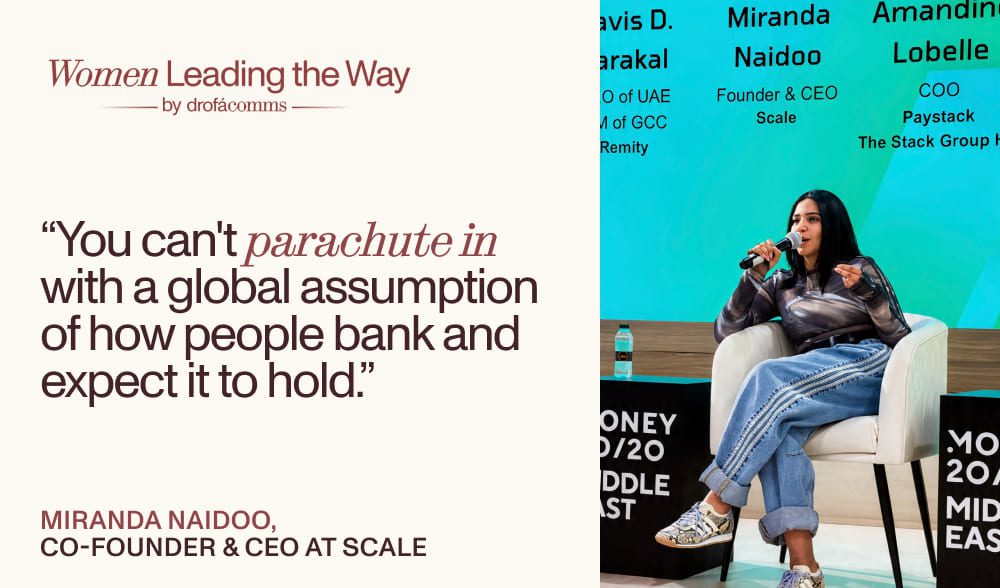
Few people have seen this complexity from as many angles as Miranda Naidoo, Co-Founder & CEO of Scale. We’re glad to announce that she’s the latest guest in our regular Women Leading the Way written interview series!
Before building her own company, Miranda spent close to a decade at Paymentology, worked across more than 30 African countries and later joined Visa. There she saw how one of the world’s largest payment networks approaches the continent.
Eventually those experiences led her to founding Scale.
One of the central topics of our conversation was the mistake international companies make when treating Africa as a single market. The continent includes 54 countries with different regulations, currencies, mobile money ecosystems and consumer expectations.
As Miranda puts it, “You can’t parachute in with a global assumption of how people bank and expect it to hold.”
We also looked at the less visible work behind launching a card programme. What sounds like a single integration may actually involve processor negotiations, licensing structures, and local banking relationships. It could also include compliance requirements and connections to domestic schemes, often repeated separately for every new country.
For fintech founders, Miranda argues, the time spent solving these issues directly takes time away from building useful products.
This is the problem Scale is trying to address. Miranda wants launching and scaling a card programme in Africa to take weeks and one integration rather than months and a separate bespoke project for each market.
Finally, our conversation moves from payments infrastructure to women building businesses in fintech. Through mentoring female founders, Miranda says she has repeatedly seen talented women wait until their plans feel completely polished. This constrained them from pitching, fundraising or asking for support.
Her experience has taught her that founders do not need to have everything figured out before taking up space. Being personally close to the problem they are solving can itself be a competitive advantage.
Read the full interview with Miranda Naidoo on Women Leading the Way!