Many fintech founders still confuse PR with marketing, as they come to agencies expecting instant visibility in top-tier outlets. Actual PR doesn’t work this way, since only long-term trust and reputation rather than on selling the idea that a company is great builds a real value.
For fintech and crypto companies, this matters even more because they operate in fast-moving markets and work with complex products. People can misunderstand even a strong product, especially if the communication is unclear. This is where PR becomes significant.
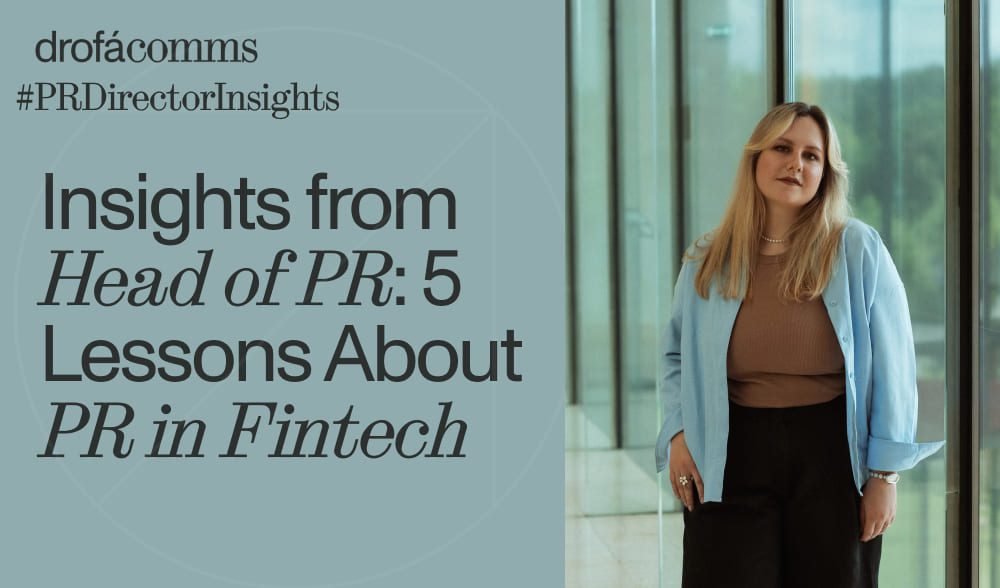
In a recent episode of the Fintech Newscast podcast, Alina Sysoeva, Head of PR at Drofa Comms, spoke about what fintech companies often get wrong about communications and how to manage them best.
Here are her 5 insights from this conversation, which would be very helpful for both PR professionals and fintech founders.
This article is part of our PR Strategy column, which will be supported by regular insights by Alina with practical observations from what she sees from the front line.
Sponsored PR Is Not Fintech PR Itself
One of the most common misunderstandings occurs when fintech clients walk in and ask PR agencies to make fast publications in top-tier media. The thing is, businesses love quick results, and that’s why packages of 10 or 20 sponsored articles are such an easy sell. However, they won’t deliver the results the business really wants, and they may quickly pass by.
“Many companies like to have big quick results publishing the news about their product. But it’s not about PR,” Alina admits.
Sponsored placements, of course, have their place, but they should be just a support to much bigger work. The actual goal is to make a company valuable enough that the media want to write about it.
It is impossible simply to replace one with another, and treating PR as a fast lead-generation channel. It is the fastest way to get disappointed by it. Many people believe that visibility itself can attract new customers, and they expect to generate new leads from several articles in the media.
In Alina’s eyes, the very first step in PR is to clarify basic business goals, understand exactly what we want to achieve. Before making any step, we need to ask the basic question, why do we want this coverage in the first place? This question is very tricky, because, in Alina’s experience, the very common answer is “because my mom likes Forbes magazine.” This, obviously, is not the best communication strategy.
“PR is about value, to make sure that everyone hears about your company and that you can work with the relevant audience.”
Earned PR Takes Time
This insight comes directly from the difference between actual and sponsored PR. To make a journalist choose to write about you takes a long time. You need to build relationships and prove that a story is worth reading. “When a journalist decides to write a story, you need to convince them to choose your company,” Alina says, “and that process runs on its own clock and rarely connects to the launch calendar.”
That is where a mismatch often occurs, as a client announces a product launch tomorrow and asks for exclusive material for a top-tier outlet, while properly pitching that story takes several weeks. The problem is that over than a half of journalists receive more than five pitches on a normal workday, and many of them almost never reply to them. Building a strong connection with the journalist sometimes may be the only way to deserve a coverage in the outlet.
To get maximum value from PR, it takes patience and getting used to the slow, consistent work of making a company’s story worth covering. This kind of work should start before there is some important event to announce.
“Clients just got back to us, and they mentioned: we will have the huge launch of the new crypto card tomorrow. And we need the exclusive on TechCrunch. But the reality is that to work with TechCrunch, you often need one month or more just to pitch the journalist the story properly.”
Earned PR surely takes time, but it will definitely be worth it. Founders rarely want to wait for so long, which is understandable. To avoid last-minute pressure while waiting until the media finally publishes coverage, it is better to make PR steady, consistent, and, importantly, planned.
Build the Crisis Team Before Crisis Comes
Crisis communication is a personal special topic for Alina, as she has experience successfully navigating dozens of them. In the podcast, she answers why bad news passes almost unnoticed for one company and explodes into tier-1 headlines for another. She states that the main thing here is preparation. After all, the companies that get hammered are usually the ones with no plan at all.
To fix it, every company needs to create an anti-crisis working group in advance. It should include employees from very different spheres, such as:
- marketing,
- legal,
- financial consultants,
- C-level,
- and, of course, the PR team.
“When clients have these working groups, it is much easier to have the on-time plan: what we announce in June, in July, in August,” Alina says. And if something breaks, the team can connect in minutes and decide on what to say and, even more important, what not to say. In that case, a company has control over communications rather than just being reactive to what is already happening in the media.
“The key reason why the crisis is usually negative and has such a huge amount of negative publications is that they are not prepared for the crisis at all.”
Going Silent During Volatility Is the Biggest Mistake
The next step in building a crisis team is to understand how it should work. In fintech, many PR campaigns are centred around big launches and events. However, the environment here is extremely volatile, and things may turn around in seconds.
When the market changes and a launch has to slip, many founders may decide that it is better to say nothing and keep silent. They don’t want to show that something went wrong or address the audience, just hoping the storm will pass. Alina saw this many times. So, she definitely may say that such a step is the single biggest communications error a fintech company can make.
The reason is that the public may consider the silence a sign of trouble and conclude that the company has nothing to say on the issue. If the business doesn’t provide firsthand information about what is going on, the media may turn to other sources that are much less trustworthy and lack actual details.
The stronger move is to stay open and reframe. “It’s okay when something just does not go as you planned, specifically for fintech and crypto companies,” states Alina, and in that case it is better to focus on positives. Talking about which users’ problems the product solves and why the wait is worth it could help regain trust.
“When the market is volatile, companies decide to keep silent and not speak to their audience. That’s the main mistake. I guess that’s the key principle which we try to use and to educate our clients.”
Women in Fintech Need Platforms Where People Hear Them
Another important topic for us is promoting women’s leadership. In the podcast, Alina touched on Women Leading the Way, a project launched by Drofa Comms to support women leaders in finance and fintech.
For Alina, this project is a platform where women can build networks and speak openly about challenges they still face in the industry. After speaking with hundreds of women leaders, she noted that many still describe situations where they were the only woman in the room or had to work harder to be recognised as leaders.
At the same time, she believes the industry is changing, recalling that in 2020, fintech and crypto events often had only one or two female representatives. Now, more women are visible here as founders and experts. This is not only a social issue, but it also leads to a maturing industry with better products and customer experience.
“It’s crucial to create a space where women can share their experiences with each other, their problems, their challenges, and how they would like to overcome them. We actually have a series of feedback from our female leaders who are on the network. They mentioned that they are very pleased that they have this space where they found new friends, partners, clients, and investors.”
Conclusion
Wrapping up, all the insights show that there is still a gap between what fintech founders think PR is and what it actually is. Confusing it with marketing and thinking that paid publications will bring you leads, or remembering it only after the crisis hits, is the way to miss out on the actual value it offers.
The earlier the company starts moving toward earned PR and learns to communicate with both clients and the media, even in times of uncertainty, the better results it will achieve. Doing so will help to go through crises even with the better reputation it gets in one.
That’s why the most important lesson from Alina is that companies need to stop thinking of PR as a last-minute tool for visibility and understand that it requires consistent work to earn trust. Payoffs, however, will be much greater than the time spent.
Stay with us for future editions, where we will bring practice and observations from the fintech market, straight from our Head of PR.