
To build trust in fintech and AI, companies need to make their technology understandable, reliable, and visible to the market. Strong products matter. Yet, trust grows when companies communicate consistently, explain decisions in plain language, and prepare clear responses before a crisis happens.
Introduction
Fintech and AI companies usually point out that they use the sharpest model and fastest infrastructure, which makes them outperform competitors. However, it is often seen that even the most technically brilliant companies struggle to win trust. Actually, this is what they may need the most.
Companies can’t operate without technical expertise, of course. Still, when it comes to winning clients and investors, those who will define the next stage of fintech and AI development will not necessarily be the ones with the best technology. More likely, it would be companies that made the market believe in it, and such beliefs can not be engineered. That’s why the only way for the company to win trust from the public is to build consistent, reliable communication.
As a PR partner to tech companies, we see this gap every day. Today, we want to talk more about why competence is not enough and what can be done to make the market actually believe in you.
Why Advanced Technology Makes Less Trust
There is an intuitive assumption that sharp technology should automatically make the product more trusted. The reality, however, is opposite. Take an AI, for example.
Today, more than two of three people use AI regularly. Yet, fewer than half are willing to trust it. What is more striking is that trust in AI has declined over the last two years despite growth in adoption. While the technology itself has become more sophisticated, people have started looking at it with caution, as they see more and more limitations and drawbacks in AI-driven products. 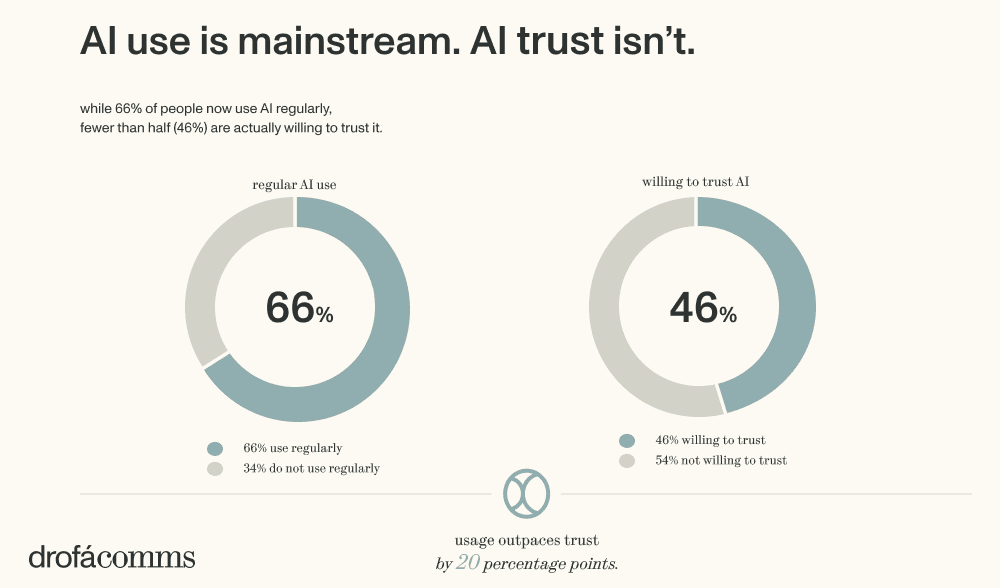
In fact, it is the case not only for AI companies, financial services have faced this gap between technical expertise and trust for years. Over the last couple of decades, finance has made great technological advances, but the sector is still ranked among the least trusted industries in the world.
Among the reasons creating such a gap, one of the most important is a disruption between market enthusiasm and internal confidence. When the market is filled with overambitious projects, it may be hard to distinguish between the actual value a company brings and its promises.
In crypto, for example, many companies promised that this technology would change financial services forever. It is doing it right now, indeed, bringing low-latency transactions and low commissions to market. However, crypto has come a long way from its initial promises to first business results.
The same is also true for AI companies. People hear enough overambitious claims that AI-driven products will change services forever. Yet, it would take a long time before AI would be broadly incorporated into business processes.
The gap between ambition and reality is the reason why technical companies need to learn how to communicate with the public and investors. Otherwise, there is a chance that consumers won’t believe promises they heard from many others.
When Competence Is No Longer Enough
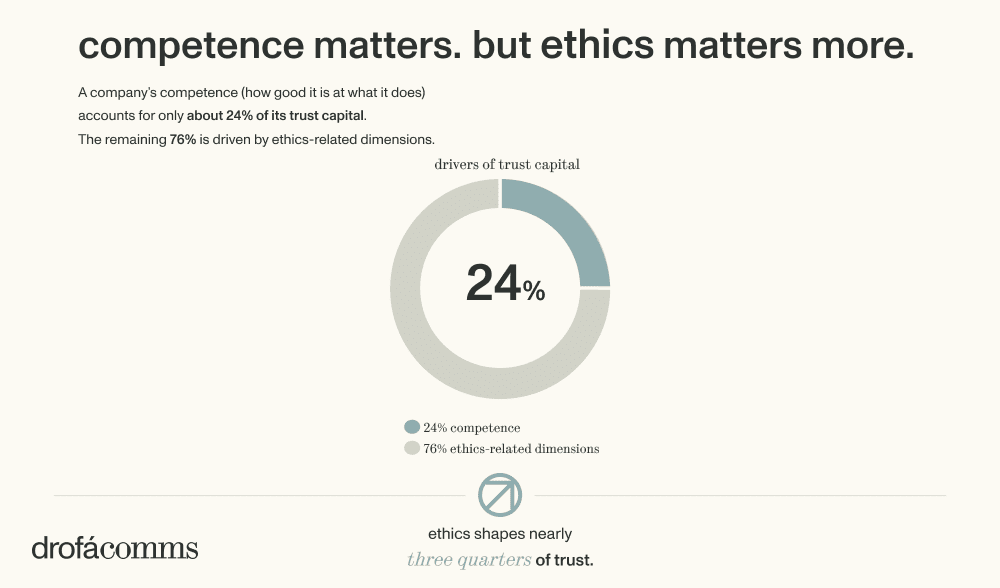
The first step in building trust with the public is to understand what actually drives it. Relying on technical expertise and sophisticated product alone is not enough, as data shows that people are three times more likely to trust a company they perceive as ethical than one that positions itself only as competent.
It is a real problem for many technical companies because many of them have traditionally overcommunicated their performance and product quality, leaving behind their intentions and purpose.
For fintech and AI, this is even more important because of the products itself. Many people consider financial and AI applications as a kind of “black box” with its own unknown logic.
How, for example, does an algorithm make a lending decision, or what data was used to train an AI model? All these questions are really important for users, because they can’t trust something invisible. To make users understand what is hidden inside that black box is a company’s purpose. It should translate technical details of the model’s tuning to a plain language that users would understand. This step can earn more trust than developing new features for a product.
To convince people that the product is really trustworthy, companies should not treat communication as another additional feature that is applied on top of the product. Businesses should view them as infrastructure, much like their codebase and payment protocols.
How to Build Trust in Fintech and AI
In our work, we consistently see five things that help the market believe in your company.
Сonsistent presence
Familiarity is actually one of the first pillars of trust. A company that shows up consistently, whether it’s the press or social media feed, feels more stable than one that shows up only when it has a new feature to announce.
It doesn’t mean, however, that one should just buy a package of 20 promoted articles and consider the work done. Communication building should be consistent.
Thought leadership
Alongside visibility, it is important to get a recognised voice on the issues your audience cares about. You need to constantly explain where the technology is going and clarify all its complexity to the market. Doing so will eventually shape the way the public is looking at your product.
Actual transparency
Almost every company claims to be transparent, but you need to go beyond just saying it. For example, when it comes to AI, people trust products with solid assurances on standards and responsible governance. And they may pay even more for products that are actually verified and transparent. To actually benefit from that demand for transparency, a company needs to actively tell how you make decisions and protect your data.
Third-party participation
People tend to believe less of what a company says about itself and more of what credible outsiders say about it. Building an ecosystem of journalists and influencers who promote your product may help drive adoption among users. People still trust social media influencers.
Crisis-ready communication
It may be one of the most important steps, because fintech and AI are the spheres where everything can change in an instant. To survive a new shock, you need to have a crisis team in place and prepared templates for how to act in every situation. It is absolutely ok to say that something has gone wrong, while the silence is what actually hurts the reputation.
Conclusion
In the fintech and AI space many companies are chasing technical excellence. They think that it may be the key to conquer the whole market. Speed is considered a virtue in these spheres, as competitors are constantly developing new products.
However, in the pursuit of speed, companies may believe that every aspect of their business, even communications, should be fast and produce immediate results. However, trust is the opposite of speed, as building it takes a lot of consistent work.
Moreover, steps to earn trust should begin much earlier than developing a new feature or a product a business wants to show to its clients. In such a dynamic environment every launch may be postponed and the agenda may change completely. When it happens, a company will face the market with the reputation it has earned earlier.
To not stay unarmed, businesses need to treat communications as something not less important than its product itself.



![Women Leading the Way: Building Community at EthCC[9] 2026 Blockchain in Cannes](https://www.drofa-ra.com/wp-content/uploads/2026/03/WLTW-Podcast-1-Site-768x452.png)