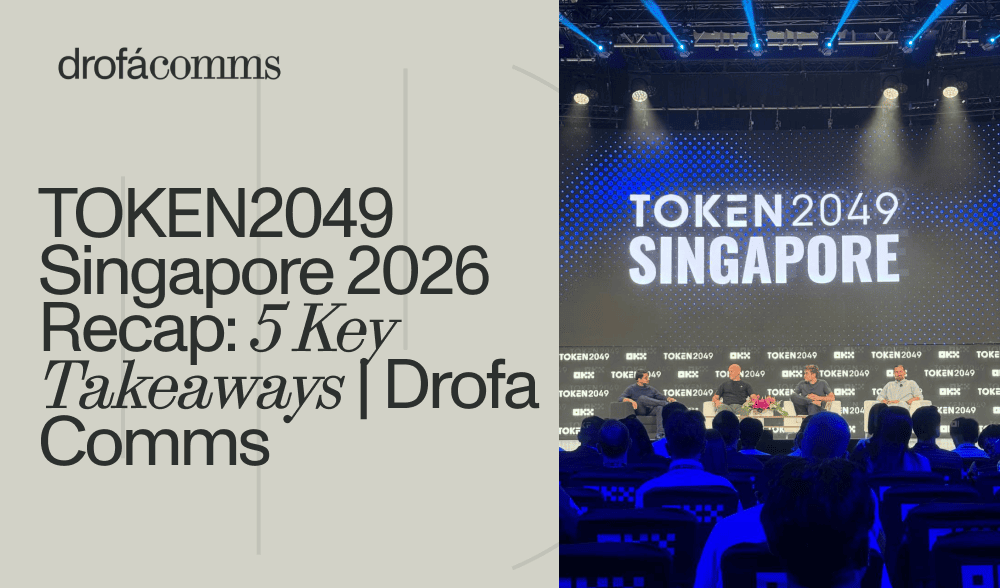
In early October in Singapore there was a grand event many crypto professionals and companies had been waiting for — TOKEN2049 Singapore 2026. During it, there were a lot of discussions covering topics ranging from tokenised funds and stablecoin payments to AI agents. The focus was on how these technologies work when actual money, legal obligations and institutional clients are involved.
The main TOKEN2049 Singapore 2026 conference took place at Marina Bay Sands on 7–8 October, with World Liberty Financial on the first day’s programme. Organisers had projected 25,000 attendees, 300 speakers and more than 1,000 side events during the week.
Our Drofa Comms team — Alina Sysoeva and Maria Tunikova — followed the week from MultiChain Day and Onchain Day through to the Ethereum Ecosystem Summit, Stablecoin Summit and RWA Summit on 9 October. Meanwhile, our Women Leading the Way initiative was an official TOKEN2049 community partner.
Below is our summary of five key takeaways from TOKEN2049 Singapore Week 2026.
1. RWA Tokenisation Needs a Market After Issuance
At MultiChain Day on 6 October, the panel “24/7 Markets: The Infra Behind Real World Assets” began with a tricky question: what happens to a tokenised asset once somebody buys it?
Dune’s Arnaud Simaret put the real-world asset (RWA) market at approximately $34 billion at the time of the discussion. Yet he argued that many existing products were never designed for active secondary-market trading. Investors subscribe through an issuer and, when they want their money back, redeem through that same issuer. So, issuing a token is possible, but finding another investor ready to buy it remains a separate problem.
The issue resurfaced at the RWA Summit on 9 October. Growth in tokenised asset value, speakers argued, does not serve as an indicator of a functioning market. A fund may exist on-chain while its underlying securities are still settled during conventional business hours. It may also be legally restricted to a small pool of eligible buyers.
As a result, ahead of 2027, the key goal for RWA issuers is to demonstrate who can trade their tokens, where the liquidity comes from and what happens if investors need to exit during market stress.
More issuance alone will not solve the core problems.
2. Stablecoins Make Payments Faster, but the Last Mile Still Matters
The international payments discussions were unusually specific about what stablecoins can and cannot solve in 2026.
During a panel on correspondent banking, speakers from Monad Foundation, Agora, Banking Circle and Gravity Team described the familiar process of sending a payment through several intermediary banks.
They concluded that stablecoins could shorten that route by moving value between two local currency providers. But, the challenge is that someone still has to exchange the money into local fiat, supply liquidity, screen the transaction and pay the recipient. This is what makes the process still complicated.
The old payment model ties up capital, too. Payment firms may keep substantial sums in overseas accounts to make transfers feel instant. For example, on the “Institutional PayFi” panel at RWA Summit, Jonathan Low of Elephants described how his business previously needed to maintain roughly $3–4 million with individual partners as payment float. Faster settlement, delivered together with stablecoins, can reduce the amount of capital tied up in those arrangements.
Banking risks remain, though. There still are counterparty exposure, credit provision, foreign-exchange pricing and regulatory checks that need to be managed on any network. So, stablecoins may shorten the payment route considerably, even so the firms handling its entry and exit points still determine whether the experience works.
3. Ethereum and DeFi Are Developing Behind the Scenes
On 8 October, the TOKEN2049 panel “Ethereum’s Next Act: From Asset to Economy” brought together Joseph Lubin, Paul Frambot of Morpho and Sam Tabar of Bit Digital. They discussed how decentralised finance could reach customers who have never opened a DeFi application.
Using Morpho as an example, Frambot explained that products might be distributed through established consumer platforms. In that case, as for the customer experience, lending and borrowing could be available inside an existing app, with the underlying blockchain barely noticeable.
Institutional firms, meanwhile, want greater control over risk, interest rates, compliance and product design. Adopting DeFi need not mean handing investment decisions to an external team. Some intend to run their own services using open blockchain software, while connecting to liquidity and investors they could not otherwise reach.
Lubin also discussed work on zero-knowledge proofs intended to connect Ethereum’s main network, Layer 2 networks and permissioned systems without depending on conventional bridges. This remains a development goal, but it addresses a problem connected with the liquidity that is split between networks becoming costly to access and difficult to coordinate.
So, for end users, the best evidence of progress may eventually be a better financial product, even if they never learn which blockchain processes the transaction.
4. AI Agents Need Spending Authority That Can Be Enforced
AI agents were present throughout the week, from the TOKEN2049 main stage to the smaller sessions at MultiChain Day and Onchain Day. Speakers were considering what happens when software can place trades, pay other agents or manage treasury accounts itself.
At the “Agentic Finance: Autonomous Capital, Execution, and AI-Native Markets” session on 6 October, the central concern was permission. An agent might detect that a lending position is at risk and propose moving collateral. Should it be able to send those funds to an unfamiliar protocol? The panel’s answer was that the owner’s mandate must control the transaction, independently of whatever the AI recommends.
One moderator captured an interesting point: “Verifiable does not mean equally profitable.” A system can faithfully execute an investment strategy and still lose money. Which is why it is important to ensure that it follows instructions, cannot broaden permissions and leaves evidence for investigating mistakes.
At Drofa Comms, we believe that discussions on AI agents could be a great starting point for financial companies if they want to implement useful automation. Giving an AI agent access to capital is easy to demonstrate onstage. Yet, making it accountable when real funds are involved is a considerably tougher assignment.
5. Institutional Adoption Will Be Measured in Everyday Use
The final day of our Singapore programme brought these topics into one room. At RWA Summit Singapore on 9 October, where Drofa Comms was a media partner, our Head of PR and Crisis Communications Lead, Alina Sysoeva, moderated “Institutional PayFi: Connecting Legacy Wealth, Digital Assets, and On-Chain Settlement.”
Her panellists — Jerald David of Lynq, Lutz Preussler of Sygnum, Jonathan Low of Elephants and Olivier Dang of KAIO — approached adoption from different ends of the financial market. Investors wanted regulated products and portfolio diversification; payment companies needed access to money outside banking hours; fund issuers looked for credible ways to settle and transfer assets.
Banks, however, must review custody, compliance, legal rights and internal systems before products reach customers. That work takes years. Some speakers thought the adoption cycle could stretch over a decade or longer, while pointing to tangible progress in tokenised money-market funds and collateral transfers.
Elsewhere at the summit, the crypto-card panel illustrated how different markets need different products. In Singapore, consumers already have convenient ways to pay. Where international cards and reliable banking are scarce, spending a stablecoin balance through familiar payment networks has more value.
What We Took Home From Singapore Week 2026
At Stablecoin Summit, we also followed our longstanding client, Curve founder Michael Egorov’s session “Purpose-Built Before It Was Cool.” Throughout the week, we were glad to meet colleagues, partners and teams building the products discussed onstage.
What we bring home from Singapore Week 2026 is that the financial industry’s next development stage depends on whether it can prove how these technologies are used.
Tokenised assets increasingly need buyers and reliable redemption mechanisms. Otherwise investors risk holding assets that are difficult to trade or use as collateral. Stablecoins, in their turn, sill need workable currency endpoints. That way they can facilitate international payments without losing their advantages.
Following straight into 2027, we expect greater attention to how these technologies perform under real market conditions. This also includes how much they actually save businesses and whether financial institutions can adopt them on a larger scale.
After all, the industry has spent years developing these solutions, so the next rational step is to make them accessible and commercially viable for the people and businesses.