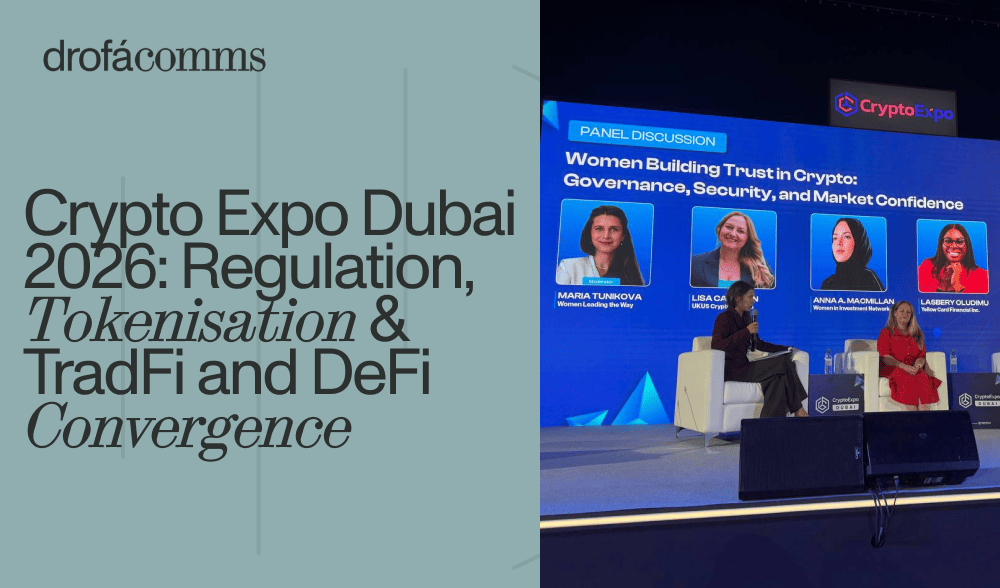
On 9–10 September, the Drofa Comms team attended Crypto Expo Dubai 2026 at Dubai World Trade Centre, joining two days of discussions around crypto regulation, stablecoins, tokenisation, DeFi and institutional adoption.
Our Women Leading the Way initiative was an official media partner of the event, which gave us an even closer view of the conversations shaping the agenda. As part of the programme, Maria Tunikova from our team moderated the panel Women Building Trust in Crypto: Governance, Security, and Market Confidence, bringing together industry leaders to discuss governance, security and trust in digital assets.
Being on the ground gave us a chance to hear where the industry believes it is heading and compare those claims with what we are actually seeing in fintech, crypto and financial communications. Some narratives are now backed by real market progress, while others still need more scrutiny.
Below are the key insights we brought back from Crypto Expo Dubai 2026.
Crypto Regulation in Dubai Is No Longer a Selling Point on Its Own
One of the strongest observations from the regulatory panels was that crypto has moved past the old debate over its regulatory status. But consistency is still what’s missing: what rules apply, how predictable supervision is and what happens when a business enters multiple jurisdictions.
Dubai gives companies more regulatory certainty than many crypto markets. VARA’s public register currently lists 56 licensed VASPs, while Chainalysis estimates that the UAE received more than $56 billion in crypto value during its 2024–2025 reporting period, representing 33% period-over-period growth.
So, calling a company “regulated” is not much of a differentiator anymore. Institutional audiences want to know what the licence actually covers, who holds client assets, how governance works and where the company is authorised to serve customers.
In short, a licence badge on a homepage says relatively little if a company cannot explain its custody arrangements, decision-making structure or regulatory responsibilities.
RWA Tokenisation Is Moving Beyond the Demo Stage
Tokenisation was probably the most persistent theme of Crypto Expo Dubai 2026, and there is now real sense behind it.
RWA.xyz data put distributed tokenised real-world assets at roughly $39.15 billion as of 8 September 2026, excluding stablecoins. At the beginning of April, the figure stood at about $27.7 billion.
Tony Ashraf, Managing Director at BlackRock, made a useful distinction on stage, claiming that tokenisation has to add utility or distribution. And this is where we actually see some of the strongest institutional use cases today — tokenised money-market funds and Treasuries, 24/7 settlement and greater mobility of collateral.
BlackRock itself provided another example in August, launching on-chain share classes for selected European money-market funds. Importantly, the blockchain layer did not replace the underlying regulated fund structure, but it changed how eligible investors could access and interact with it.
Still, creating a token does not verify the asset underneath it.Provenance, custody, legal ownership, redemption and secondary-market liquidity remain separate concerns — a point that also came through strongly in discussions around commodity tokenisation and traceability.
Stablecoins Have the Strongest Product-Market Fit
The global stablecoin market stood at roughly $304 billion in mid-September 2026. At Crypto Expo Dubai, speakers repeatedly framed stablecoins less as speculative instruments and more as payment and settlement infrastructure.
This idea sounds credible.
The UAE already has a dedicated Payment Token Services Regulation covering payment token issuance, conversion, custody and transfer. The real value of stablecoins is that businesses and financial institutions can move money faster, with payments settled around the clock and fewer intermediaries involved, reducing back-office work.
What is less convincing is the idea that every market therefore needs another stablecoin.
A local stablecoin used only inside a local ecosystem may solve very little — an issue raised directly during the BlackRock discussion. Distribution, redemption, regulatory treatment and cross-border usefulness still determine whether the product has a reason to exist.
We think describing a product as a “compliant stablecoin” says relatively little on its own. What matters more is explaining the underlying mechanism in simple terms, so users can understand how the product works and where its value comes from.
DeFi and TradFi Are Converging, but Selectively
Several speakers described the boundary between traditional finance and DeFi as disappearing. We would qualify that.
What is scaling institutionally is not necessarily the old “replace the banks” version of DeFi. Traditional financial institutions are adopting the parts of DeFi that solve real problems — such as 24/7 settlement, programmable transactions and on-chain collateral — while keeping them within regulated boundaries.
Canton Network offers a good version of this model, with institutional use cases focused on collateral, repo and synchronised settlement. This includes work involving intraday financing and tokenised Treasuries.
Indeed, this is convergence, but largely on institutional terms. It would be more accurate to say that DeFi infrastructure is being adapted to meet the requirements of traditional finance.
What’s Next After Crypto Expo Dubai 2026
Crypto Expo Dubai 2026 showed that many of the most discussed topics in fintech and Web3 are becoming more serious than ever. Regulation is finally taking clearer shape, tokenisation is finding institutional use cases, while stablecoins are already deeply embedded in payment infrastructure.
Being on the ground at the event, we noticed that the industry is generally moving in a positive direction. There are still gaps, of course. Some market participants are still trying to understand how to use these technologies in practice, others, meanwhile, implement them without a use case or communicate them poorly in the media, news coverage and press releases. Still, the progress is here.
This is what we brought back home from Crypto Expo Dubai 2026, and we will continue following how these trends develop in the months ahead.
Stay with Drofa Comms for more insights from the fintech, crypto and financial industries. And if your company needs PR support to communicate its story to the right audiences, contact us at marketing@drofa-ra.co.uk.